Case Study: Two funders who have rethought overhead costs
A big thank you to Charlotte Goninan and Lauren O'Shaughnessy, as well as the Goninan Family Foundation and the Macquarie Group Foundation, for sharing their stories and supporting the movement.
Our data shows us that 25% of Australian charities operate at a deficit, and 77% report a strain on their financial resources. The key drivers of vulnerability are insufficient funding for overhead costs, otherwise known as indirect costs or administrative costs. These are costs incurred by an organisation that cannot be directly and easily attributed to a specific project.
Pay What It Takes (PWIT) believes there are multiple ways to recognise and address the full cost of delivering impactful work – whether it’s talking transparently about indirect costs, reframing overheads or advocating for full cost funding.
Navigating conversations with funders about overhead costs can feel daunting, especially when funders hold varying views on what they are willing to support. Yet our PWIT Report highlights that 70% of funders are willing to engage in open dialogue about funding overheads, but only 32% of NFP believe funders are. Understanding how funders in Australia think can help you advocate effectively for the true costs of delivering your purpose.
Two funders who have rethought overhead costs
Charlotte Goninan and Lauren O’Shaughnessy work with funders who exemplify the evolving mindset around funding for-purpose organisations’ overhead costs.
Goninan Family Foundation
Charlotte Goninan experienced a pivotal moment of insight when her late father, initially sceptical of funding operational expenses, toured a NFP’s warehouse. When he asked what would happen if the organisation couldn’t pay its rent, the stark response— “We don’t have a charity”—reshaped their family foundation’s funding philosophy.
Since then, Charlotte’s family foundation has embraced trust-based philanthropy, providing untied, multi-year funding to address for-purpose organisations’ core needs.
Macquarie Group Foundation
Lauren, the Global Director of Impact for the Macquarie Group Foundation, has spearheaded the organisation’s shift away from program-specific funding to supporting core operational expenses.
Influenced by global equity movements and the pandemic’s financial strain on NFPs, Lauren has championed conversations about true costs, with the goal of ensuring grantees have the resources to sustain and scale their impact.
Funders Value Transparency, Don’t Undersell Costs
Transparency is a recurring theme in funder expectations. Funders want to understand your organisation’s full cost structure and need for-purpose organisations to be honest about what it truly takes to succeed.
Many funders, like Charlotte Goninan, express frustration when for-purpose organisations underreport their costs out of fear of rejection. “If it costs half a million dollars, say so. Lowballing only hurts the for-purpose organisation in the long run.”
This means being prepared to discuss not just program costs but also indirect expenses needed to run the non-profit—rent, IT systems, staff salaries, fundraising, measurement and evaluation and more.
Trust grows and constructive conversations can be held when for-purpose organisations are upfront about their operational needs and can link those needs to impact and outcomes.
Reframing Overhead as core business Investments, not an “Admin” Expense
Language matters. Words like “administration” or “overhead” often carry negative connotations, reinforcing outdated assumptions that these costs are wasteful.
Funders like the Macquarie Group Foundation emphasise the importance of reframing. “We’re interested in funding the organisation, not just the programs,” Lauren shared. “Overheads like rent or core staff are critical to achieving the desired outcomes so we want to know about these costs too”.
Instead of defaulting to terms funders may view sceptically, use language that highlights the value of these investments.
Reframe Overhead research has shown that people respond better to terms like “governance,” “effectiveness,” “impact enabling,” or “mission-critical operations” rather than administration costs.
Work With Funders As Strategic Partners
A growing number of funders are embracing multi-year, untied funding, working with organisations as long-term strategic partners.
“We want to help beyond just funding. Let’s talk about your strategy and ambition, the gaps, and how we can fill them.” – Charlotte Goninan
The Goninan Family Foundation is a prime example, committing to untied multi-year funding for operational expenses like rent and staffing. “By covering rent for three years, we freed up resources for strategy and sustainability,” Charlotte explains.
This approach allows for-purpose organisations to focus on long-term planning instead of scrambling for short-term fixes. It also appreciates the program operates in a whole-of-organisation ecosystem that needs to be functional first if it’s ever going to thrive.
Engaging Funders Across the Spectrum
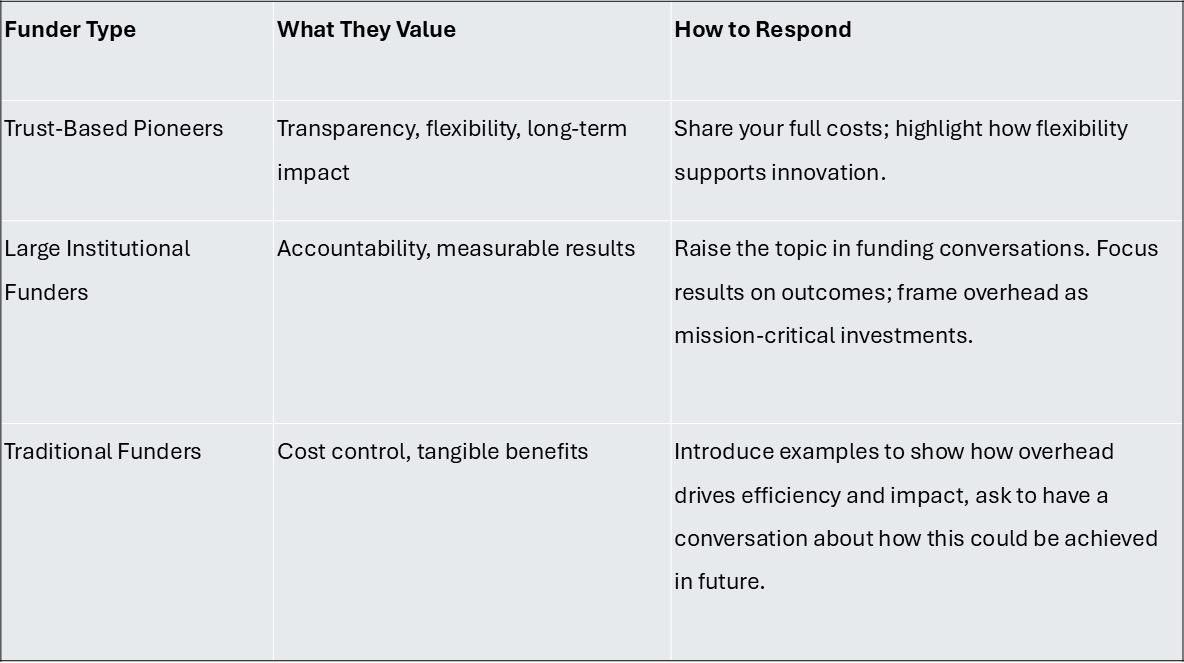
Not all funders are aligned on this thinking. Some remain tied to the traditional model of limiting overhead funding, while others are open to exploring new approaches in a cautious manner. To effectively engage funders along this spectrum, for-purpose organisations must tailor their strategies and communications:
Practical Tips for Funders & Fundraisers
Prepare to Explain Overhead Costs Clearly: Break down budgets into specific categories and focus on how each cost contributes to impact. Reframe Your Language: Check out the NFP Guide with key facts, language and practical steps to start reframing overhead costs. Avoid terms like “administration” and instead use language such as “effectiveness,” “governance,” or “mission-critical investments.”
Lean Into Multi-Year Support: Highlight how consistent funding allows your organisation to plan strategically, innovate, and achieve sustainability.
Treat One Another As Strategic Partners: Schedule regular check-ins to discuss progress, challenges, and strategic opportunities to engage as collaborative partners.
Conclusion
Reframing overhead costs is not just a funding strategy; it is a commitment to equity, trust, and sustainability. We need to open the conversations, represent reality, and not shy away from an accurate picture of the contributions of all areas of the business.
For-purpose organisations need to provide transparent reporting and acquittals and start to shift the focus to the impact the funding will enable. Funders should engage in
conversations about what’s required, challenge the status quo, and be open to new approaches and models for funding.
By embracing the "Pay What It Takes" approach, funders can empower for-purpose organisations to thrive, innovate, and deliver transformative change. This shift requires courage and collaboration but promises a stronger, more resilient and effective social impact sector.